Gatchalian flags
stagnant immunization rates, nearly P600M in vaccine wastage
By
SAMAR NEWS.COM
September 5, 2026
CATBALOGAN CITY –
Senate President Win Gatchalian, a commissioner of the Second
Congressional Commission on Education (EDCOM 2), has raised alarms
over the Philippines’ stagnant childhood immunization coverage and
massive vaccine wastage, calling them major barriers to early
childhood development and long-term learning outcomes.
During a Senate Committee
on Finance hearing on the proposed FY 2027 national budget,
Gatchalian highlighted that funding for the National Immunization
Program has climbed to P7.9 billion, with procurement for routine
vaccines in the first 1,000 days of life nearly doubling from P2.56
billion in 2023 to P4.93 billion in 2025. Despite the increased
spending, Fully Immunized Child (FIC) coverage has remained stuck
between 60% and 65% for the past five years, leaving roughly 35% of
infants unprotected against preventable diseases.
“Despite the increase in
budget, nakikita namin na ‘yung coverage is only 65%,” Gatchalian
told Department of Health (DOH) Secretary Edwin Mendoza. “Dapat
non-negotiable ‘yung first 1,000 days. I’m sure you know na ‘pag
lumampas ng 4, 5 years old, irreversible na ‘yan eh, no?”
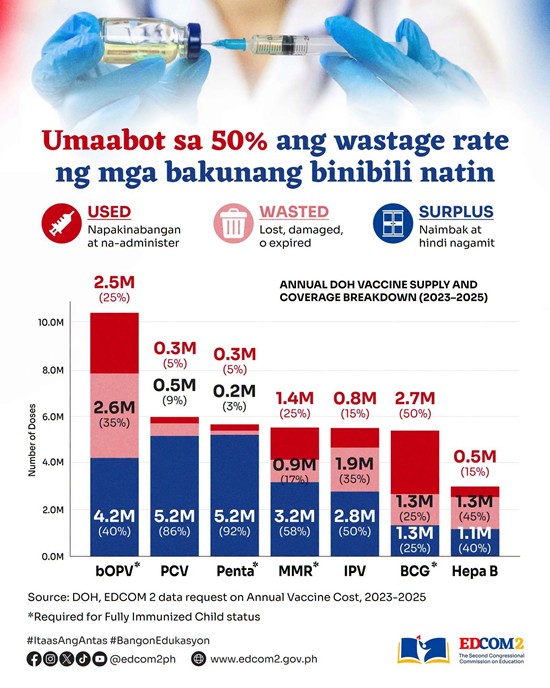
EDCOM 2 data visualized in
a new infographic underscore the scale of inefficiency. An analysis
of annual DOH vaccine supply from 2023–2025 shows wastage and
surplus reaching critical levels across key antigens. For BCG, 50%
of doses (2.7 million) were used while 25% were wasted and another
25% left in surplus. IPV saw 35% wastage (1.9 million doses),
hepatitis B 45% wastage (1.3 million), and bOPV 35% wastage (2.6
million). Several vaccines, including PCV and Pentavalent, showed
surplus rates above 85–90%, meaning the vast majority of procured
doses went unused.
Using DOH wastage
benchmarks and procurement costs, EDCOM 2 estimates P590.3 million
worth of vaccines were wasted in 2025 alone. The benchmarked 50%
wastage rate for BCG translates to roughly P51.2 million lost, while
the 25% rate for MMR accounts for about P254.5 million.
“Only 60% of [children in
their] First 1000 days ang nabibigyan ng immunization, and yet
maraming wastage ang nangyayari – about half a billion ang
nasasayang. So kung nabi-nabigay natin yung half a billion doon sa
mga batang yon…baka 70%-80% ng mga bata ang maimmunize natin,”
Gatchalian said. He pinned the problem on poor inventory management
rather than lack of demand: “Inventory problem is something that you
need to put a lot of attention kasi ang daming perang nasasayang
eh.”
The senator linked the
failures directly to the country’s learning crisis. Children who
miss critical immunizations and nutrition in the first 1,000 days
often enter school already stunted or wasted – conditions from which
full recovery is unlikely. DOST-FNRI data show stunting rose to
25.3% in 2025, up from 23.6% in 2023, the first increase in a
decade.
“Kahit anong investment
natin sa education, kung papasok sila na stunted, wasted,
underweight tapos na ‘yung boxing eh…Hindi na sila makaka-recover,”
Gatchalian stressed.
In response, Secretary
Mendoza acknowledged deep inventory and last-mile delivery problems.
He said the DOH is overhauling its systems to track children from
pregnancy onward through expanded primary care networks and
PhilHealth database integration, aiming to raise vaccination rates
and lower stunting before children reach preschool
“Hindi lang po ‘pag na-newborn
kundi ang ginagawa po natin ngayon, even during the pregnancy stage
kina-capture na po natin,” Mendoza said. He pledged to push tracking
and commodity distribution down to rural health units and barangay
level so vaccines actually reach communities. Gatchalian urged the
department to download stocks directly to municipal health centers
so barangay health workers can conduct proactive house-to-house
immunization.
EDCOM 2 has repeatedly
warned that without fixing foundational health and nutrition gaps,
education reforms will continue to fall short. The commission is
calling for tighter accountability on vaccine logistics and a
non-negotiable focus on the first 1,000 days.