Marawi buildings – with
a price tag of P10B – are ready but empty
The
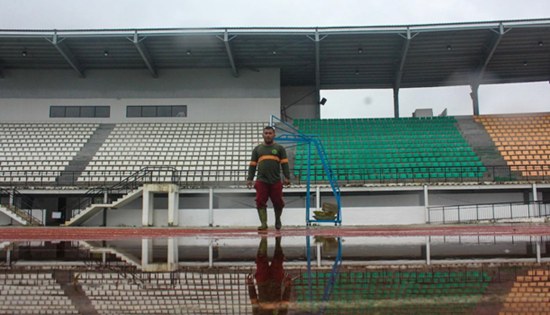
Sarimanok Sports Complex, which faces Lake Lanao, has a seating
capacity of 3,700. (photo by Bobby Lagsa) |
Marawi homes remain in
disrepair as P10-B is poured into the construction of government
buildings. Displaced residents are now pinning their hopes on the
newly constituted Marawi Compensation Board. But big challenges lie
ahead.
By CARMELA FONBUENA
Philippine Center for Investigative Journalism
March 2, 2023
The
bridges and the roads in Marawi City are sparkling and brand new,
but close to six years since followers of jihadist group Islamic
State laid siege to its city center, it’s still the sight of
abandoned and bombed out homes that immediately welcome visitors of
the former ground zero.
Past the Mapandi Bridge, which separated the safe zone and the
battle area in 2017, the pink walls of a newly painted commercial
building stood tall amid ruins. Nearby, a repaired house was painted
a neutral gray. They were few and far between.
The former site of battles is now called MAA or the “most affected
areas.” Life stood still here unlike the rest of Marawi City, called
the least affected areas or LAA, where residents returned and
rebuilt after the siege and new hotels have risen as well as coffee
shops that cater to visiting donors and development agencies.
There was a heavy downpour when the Philippine Center for
Investigative Journalism (PCIJ) visited the MAA in late January. The
first villages upon entry showed the presence of some residents, and
a few tricycles and private vehicles drove by. The humming sound of
electric saw and hammers hitting nails could be heard here and
there.
But deeper into the MAA, there was hardly no one. There were new
gates, but no work was done on the rest of the property.
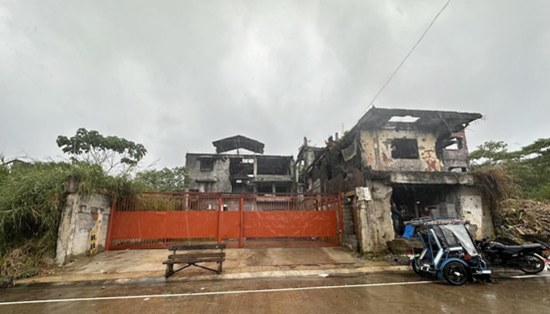
Most
Marawi houses remain in disrepair. (photo by Carmela Fonbuena) |
Homes in these areas survived military air strikes during the
battles. The government wanted to demolish many of them at the start
of the rehabilitation work, citing safety considerations, but
residents protested. The large graffiti of the names and mobile
numbers of owners on walls pockmarked by bullets and bombs are
declarations of ownership, an assertion of their right to decide
what they would do with the property. A few cases of illegal
demolition are pending in courts against Task Force Bangon Marawi (TFBM),
the agency in charge of rehabilitation.
Time has doomed the abandoned Marawi homes to decay. But not the
government buildings. They were bright and shiny. New barangay
complexes, which cost almost P14 million each, have been completed
as well as village mosques and some school buildings. The police,
jail, and fire stations were almost done.
Electricity lines were in place. There was no power yet but the MAA
is expected to be connected soon. There were sun-powered light
posts, too. It’s the water source that is problematic.
|
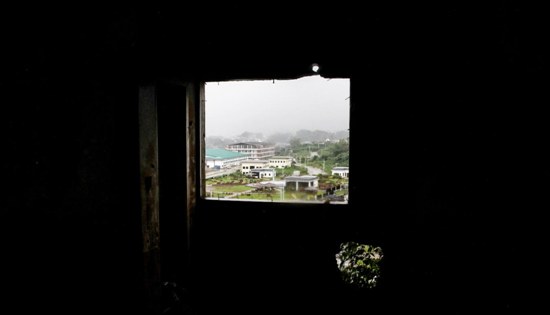
The
big-ticket infrastructure projects are in sector 8 and 9 of the
MAA. Government funds did not cover the rehabilitation of
private properties. (photo by Bobby Lagsa) |
A total of P10.2 billion was released for the rehabilitation through
the years. The big-ticket infrastructure projects could be seen past
the rows of derelict homes, where modern public infrastructure was
built by the banks of scenic Lake Lanao. Many buildings were ready,
but without the residents, they were empty.
Samira Gutoc, an NGO leader, said the residents’ return to their
properties should have been the priority. She has been fighting for
residents’ right to return “without conditions.”
“Each house is crying for help. Naging secondary na ang bringing
back people. Di ba ‘right to return’ naman ang battlecry (Bringing
back people became secondary. Isn’t the battlecry ‘right to
return’)?” Gutoc said.
Not even 1% of MAA residents have returned
Only 100 families have been permitted to return to the MAA after
some repairs or reconstruction, based on data from TFBM, although
residents claimed a few families have returned without government
approval. It is not even one percent of over 17,793 households
displaced at the MAA during the siege.
A total of 953 families were resettled in permanent shelters and
4,916 others are still in transitory shelters elsewhere. The rest
have found temporary homes elsewhere.
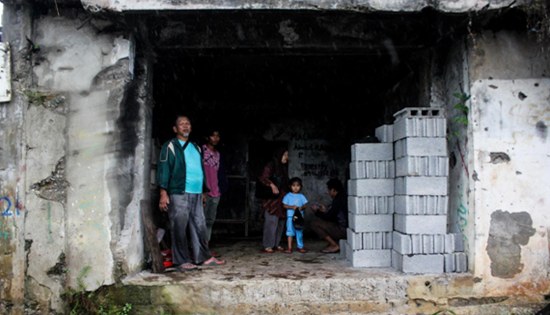
Residents
visit their homes in the former battle area.
(photo by Bobby Lagsa) |
PCIJ chanced upon Rashmina Macabago, 57, at her family compound in
Brgy. Kapantaran. They secured a building permit before the pandemic
hit in 2020, but they did not have the funds to repair the property.
She and a few family members arrived with some construction
materials to reinforce a post that was already tilting. They hoped
to avert any further damage to the structure.
“Pera ang problema. Naghihintay kami sa ipamimigay. Wala pa rin (We
don’t have the money. We are waiting for what they will give us.
There’s none yet),” said Macabago.
Drieza Lininding, chairman of Marawi civil society organization Moro
Consensus Group NGO, said many residents cannot afford the
requirements to secure building permits, and not all who have
permits already have the money to buy construction materials. Many
others now live far away and cannot afford to return, he said.
The Marawi City local government unit (LGU) has so far only received
2,947 applications or 16.6% of households in MAA. Even for those who
could manage to afford processing building permits, Lininding said
there were fears that residents who have repaired their homes will
no longer be eligible for compensation. They will need the assurance
that it’s not true.
P10-B poured into government infra
The accomplishments of the
rehabilitation can be seen at the banks of Lake Lanao, the heart of
Marawi’s former city center which saw the fiercest battles and where the
siege leaders were killed. All but a few old structures were demolished
to make way for new buildings. It’s a reclamation area that the city
government said is government property, but which residents are
contesting.
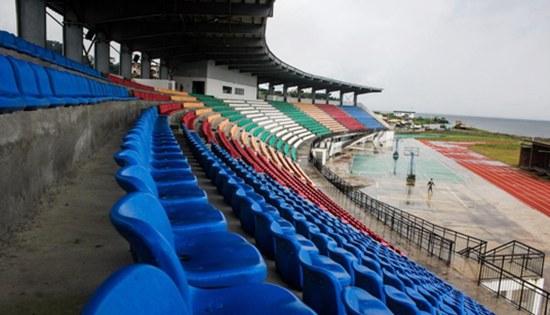
The
Marawi Sports Complex has basketball courts, a running track,
and a football field. (photo by Bobby Lagsa) |
The new Sarimanok Sports
Complex can seat 3,700 spectators. The running track was newly painted
and goal posts were already placed at the football field. It can host
games for the youth not just in Marawi and Lanao Del Sur province but
all over the country. Marawi Mayor Majul Gandamra’s smiling photo
appeared in a banner on a makeshift stage, hung during his enthronement
and coronation as sultan, a traditional leader. Events like this
occasionally bring residents back to the MAA, but they leave as soon as
the activities are done.
Adjacent to the sports complex
is a one-hectare convention center that can host indoor events such as
weddings of Marawi’s rich and powerful. Inside, there’s an auditorium
with 1,000 seating capacity. Workers were already installing seats. An
engineer introduced himself to PCIJ to say that visitors were not
allowed yet, but the TFBM staff sorted it out immediately.
The white and green minaret of
Bato Mosque, where the militants holed up with their hostages for
months, now stands beside the newly built Marawi museum. Bato mosque
itself has been reconstructed and has taken a modern look. The Grand
Mosque, too, has been repaired and has changed its color from green to
gold.
The rehabilitation work was
divided into 22 projects, out of which 17 were completed or almost
completed as of December 2022, according to TFBM’s December 2022 report.
The rest of the projects are to be completed by December 2023, the
report said.
More than half or 56% of the
funds went to the National Housing Authority (NHA). It cost the agency
P2.3 billion to clear bombs and debris and P3.17 billion to construct a
road infrastructure, which has an underground facility.
|
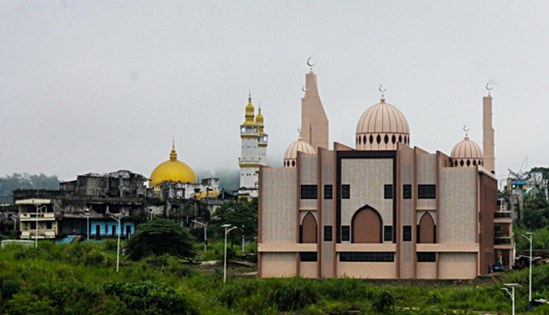
Bato
Mosque (front) was reconstructed to take on a modern look while
the grand mosque was repaired and repainted. Both mosques became
strongholds of the militants during the siege.
(photo by Bobby Lagsa) |
The Marawi City LGU received
almost P2 billion or 19% of the funds for the construction of projects
such as the Grand Padian Central Market (P443.25 million), the Peace
Memorial Park (P312 million), the Lake Lanao Promenade (P380 million),
and 24 barangay halls.
The Local Water Utilities
Administration (LWUA) was allocated about P1 billion for the
construction of a Bulk Water System and Sewerage Treatment Plant, but
the agency has yet to begin its work. TFBM Field Office Manager Felix
Castro Jr. said they are expecting quicker action from the new head of
the agency.
Marawi Compensation Board
Residents are now pinning
their hopes on President Ferdinand Marcos Jr. to fulfill the failed
promise of his predecessor. Marcos finally appointed the members of the
Marawi Compensation Board (MCB), a body created under Republic Act 11696
to provide compensation for the loss or destruction of properties and
loss of lives as a result of the 2017 Marawi siege.
Lawyer Maisara Dandamun Latiph,
the newly appointed MCB chairman, told PCIJ the board will fast-track
its processes. She said they are planning to conduct consultations in
the next two to three months in order to finish the implementing rules
and regulations (IRR) of the law.
The board aims to formally
begin accepting claims by May or before the siege marks its sixth year.
She recognized that big
challenges lie ahead. “We are expected to deliver our mandate to pay the
monetary compensation for the personal properties as well as
[compensation to the families] of [those who are] legally presumed dead
and missing persons. We will also recommend interventions for further
recovery and rehabilitation,” Latiph told PCIJ.
The board has an initial
budget of P1 billion for the compensation of siege victims. The maximum
amount claimants may receive is yet to be determined, she said.
Latiph, who once belonged to
the NGO community, has the support of civil society organizations. They
are counting on her to champion their causes.
Bean There, Done
That: Exporting to the European Union
|

AURO
chocolates, a Filipino company, is one of currently, only 24
companies in the country who are able to export products to the
European Union tariff-free under the EU’s Generalized System of
Preferences Plus (GSP+). |
Philippine chocolate firm
exports to the EU
By
DTI-KMIS Information
and Creative Service Division
January 16, 2023
New beginnings
It was in 2013, while finishing her university degree in Chicago,
that Kelly Go got a taste of an American craft chocolate using
Philippine-origin cacao.
From this point, her career aspirations became clearer. After
graduation, she decided to learn more about this craft by enrolling
in Le Cordon Bleu in Paris for a Diploma in Culinary Arts. This
training further enhanced her knowledge and skills about the food
business.
The love for food, culture, and chocolate directed her destiny in
Germany where she deepened her expertise in industrial chocolate
production.
“We saw the potential of elevating the fine chocolate market in the
Philippines and an opportunity to pursue our shared dream to move
back home and contribute,” Kelly shared.
Responsible production
Their company, Auro Chocolate, was eventually launched in 2017 as a
tree-to-bar chocolate brand and social enterprise introducing
community development programs and premiums above commodity price
for supporting farmers.
|
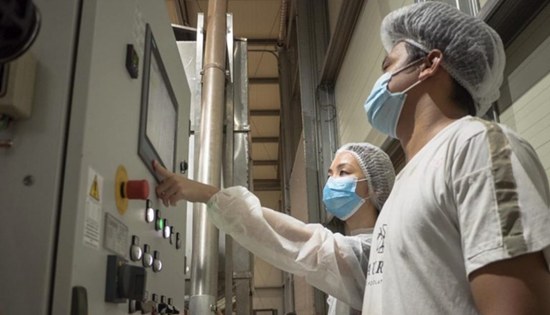
Kelly
Go, co-founder and manager of AURO Chocolate, talks with
operators of the grinding machine at the AURO chocolate
plant in Calamba, Laguna, in the Philippines. AURO Chocolate
benefitted from the EU’s GSP+ programme which facilitates
the entry of certain products tariff- free into Europe. |
With all beans directly sourced, Auro is promoting sustainability by
working directly with local farmers to cultivating fine cacao beans,
improving ingredients, and expanding retail products with unique and
bold tropical flavours, such as dried mango.
From a team of 20 staff, it has grown to over 100 employees working
towards the export of its products to the European Union (EU) and
other countries since 2018.
We involve ourselves in every step of the process by consistently
working with our partner farmers to enable them to produce fine
quality cacao beans that meet international quality standards,”
Kelly added.
Breakthrough
There were challenges to be hurdled before successful exports to EU
could materialize.
“At selling events, people would question the quality of our
products as chocolates from the Philippines are unheard of,” Kelly
said.
To win the trust of consumers regarding chocolate products grown and
made in the Philippines, Kelly must be abreast of mandatory
procedural requirements.
The Philippine Department of Trade and Industry (DTI) – Export
Marketing Bureau (EMB) assisted Auro in completing the mandatory
regulatory requirements for exporting in EU. The Centre for
International Trade Expositions and Missions (CITEM) further
supported the company in organizing country booths in key
international trade fairs such as Salon du Chocolat in France.
The initiatives worked wonders for generating interest in Auro’s
fine cacao.
A plus for the business: GSP+
Sales have increased by almost 200% since the Covid pandemic. Auro
is directly exporting to more than 15 countries with over 40
European chocolate makers using the company’s fine cacao beans to
make Philippine-origin chocolate.
Kelly was delighted to learn that chocolatiers in the EU countries
were using her company’s chocolate products. Being able to export to
the EU means that Philippine cacao can compete globally with other
well-known chocolate brands.
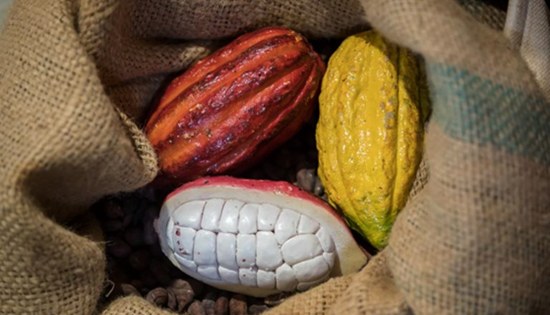
The EU’s Generalized Scheme of Preferences (GSP+) removes import
duties from products coming into the EU market from developing
countries, thus, Kelly was able to competitively price her products
vis-à-vis other brands.
“Our chocolate bars are doing well due to GSP+, which serves as a
gateway support to the EU market,” Kelly added.
Kelly is proud of her products being able to stand side-by-side with
other internationally known brands, allowing her company to continue
to grow business with their EU partners.
Gaining together
The resultant increase in sales has benefited Kelly, together with
those who work for her company.
“Thanks to the GSP+ status, we have become part of the international
cacao beans market, which led to an increase in our sales. This
means there is a growing demand for our partner farming community’s
beans, thus generating more income for them, while providing a
stable market for their cacao.”
Moving Forward
Auro chocolates is ready to set higher standards of achievement
under Kelly’s leadership:
“We have exciting plans. On the farm side, we are to launch more
community initiatives that are interwoven with our current cacao
program. We are also expanding our sourcing to introduce new,
exciting origins of chocolates. Shifting to more environmentally
friendly practices and materials across the supply chain is also on
the cards.”
She leaves an inspiring message for aspiring exporters from the
Philippines: “Do not feel intimidated when trying to apply for GSP+.
DTI is there to assist you throughout the application and help make
your brand marketable. It’s also a great opportunity for your
products to be introduced and grow in the EU Market.”
Detained mother
reunites with daughter after 30 years
|
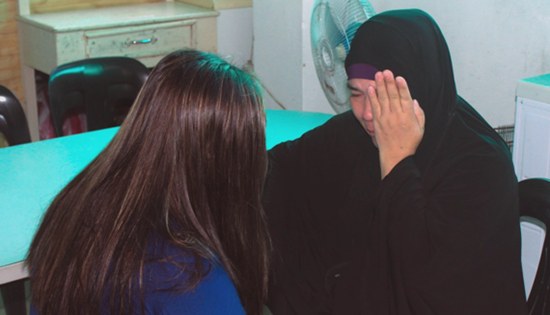
Anne
reunites with her daughter Jennifer at the Correctional
Institution for Women (CIW) in Mandaluyong City, Philippines.
(Photo by CIW) |
By
ICRC
October 20, 2022
MANILA – "Nasaan
ang anak ko? (Where is my daughter),” asked Anne* looking straight
at Jennifer*, who was introduced to her by a staff of the
International Committee of the Red Cross (ICRC). Smiling,
36-year-old Jennifer pointed to herself. They had last seen each
other over 30 years ago. Continuing to look at the younger woman
with some disbelief, Anne recalled that her daughter had a birthmark
somewhere around the nape of her neck. As she spotted it on
Jennifer, they were both overcome with emotions and embraced
tightly.
Jennifer was only six
years old when Anne was offered a job as a saleslady in Malaysia.
Like many Filipinos in search of a better life, she accepted it. “I
did not tell my mother that I wanted to work abroad because she
would have refused to let me go. So, I just left without a trace. I
was sure I would come back and my family would understand me because
I did it for them,” said Anne.
But the job in Malaysia
turned out to be a scam. Anne was tricked into becoming an
entertainer with a measly salary. When she was released from that
job, Anne became a domestic help and then toiled as a construction
worker.
After her contract ended,
Anne returned to the Philippines in 2006. However, she did not go
back to her family because she was afraid to see her mother. “I
thought she would reproach me for what I had done. I convinced
myself to pretend as if I were dead to my family,” she said, adding
that she chose to settle in another village in Mindanao and started
a farm.
Detained in the
Philippines
In 2017, Anne was arrested
in relation to armed conflict. The ICRC visited her at Taguig City
Jail a few months after her arrest as part of its humanitarian
mandate and activities in the Philippines. “We have been helping
detainees all over the world for more than 150 years, focusing on
people deprived of their liberty in relation to armed conflicts and
other violence. We look into how detainees are treated during their
arrest and detention and monitor their health and living conditions.
We also help to restore and maintain communication between detainees
and their family members,” explained Alvin Loyola, the ICRC staff
who accompanied Jennifer to meet Anne.
Anne learned about the
ICRC’s Family Visit Programme (FVP), under the Restoring Family
Links (RFL) initiative, to help detainees separated from their loved
ones because of armed conflicts. The RFL initiative involves tracing
detainees’ family members, re-establishing and maintaining contact,
reuniting families and seeking to clarify the fate and whereabouts
of those who remain missing. Through the FVP, families of detainees
can travel from their hometowns to visit their detained loved ones.
“It is very important because it allows detainees to re-establish or
maintain contact with their families and improves their
psychological well-being,” said Mariegen Balo, ICRC staff.
Anne also desired to meet
her daughter when she found out her whereabouts through relatives.
But the programme was suspended in 2020 because of the COVID-19
global pandemic. When the travel restrictions were eased in 2022 and
family visits resumed, the ICRC scheduled Anne’s long-awaited
reunion with her daughter.
Together at last
 In July, an ICRC team
accompanied Jennifer to visit her mother, who is now detained at the
Correctional Institution for Women (CIW) in Mandaluyong City. Anne
said she did not know how she would approach her daughter, whom she
had last seen three decades ago. “I wondered, should I ask for
forgiveness first, or do I just hug her?”
In July, an ICRC team
accompanied Jennifer to visit her mother, who is now detained at the
Correctional Institution for Women (CIW) in Mandaluyong City. Anne
said she did not know how she would approach her daughter, whom she
had last seen three decades ago. “I wondered, should I ask for
forgiveness first, or do I just hug her?”
But Jennifer, who had
managed to beat the odds and graduate from college with her
grandmother’s help, said her mother did not need to worry at all.
Even though they had not been in contact for 30 years, Jennifer said
she did not harbour any resentment against her mother. In fact,
every year on 30 January – Anne’s birthday – Jennifer would put a
post on social media in her honour. “The only photo I had of my
mother was destroyed in a flood so I used photos of my siblings and
me for the posts. I used to pray hard for the day that I would see
her again,” said Jennifer.
The mother and daughter’s
reunion happened just a few days after Jennifer’s 36th birthday, so
the ICRC team asked Anne about her wish for Jennifer. “I wish her
more happiness in life and that she may be given more
opportunities,” said Anne.
As part of the FVP, Anne’s
family will make two ICRC-supported visits every year to meet her.
Now that she has been reunited with Jennifer, Anne said she looks
forward to making up for lost time.
*Names have been changed to protect identity.
2021 Eastern Visayas poverty situation
22 in every 100
families in Eastern Visayas are poor
By
PSA-8
October 14, 2022
TACLOBAN CITY -
Poverty incidence among families in Eastern Visayas in 2021 was
estimated at 22.2 percent. This implies that in 2021, about 22 in
every 100 families in the region were poor or have income that were
below the poverty threshold, or the amount needed to buy their basic
food and non-food needs.
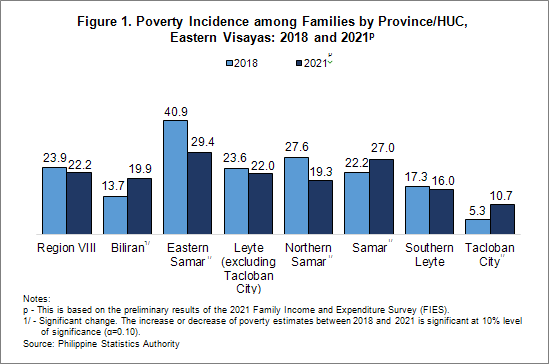
Among provinces, Eastern
Samar posted the highest poverty incidence in 2021 at 29.4 percent,
while Southern Leyte registered the lowest poverty incidence among
families at 16.0 percent. Eastern Samar and Samar registered higher
poverty incidences among families than the regional level in 2021,
while the rest of the provinces posted lower poverty incidences than
the regional estimate at 22.2 percent.
Significant improvements
in poverty incidence among families were noted in Eastern Samar and
Northern Samar. Poverty incidence among families in Eastern Samar
dropped to 29.4 percent in 2021 from 40.9 percent in 2018. The
province of Northern Samar, meanwhile, registered 19.3 percent
poverty incidence among families in 2021, lower than the 27.6
percent in 2018. On the other hand, poverty incidence among families
in Biliran significantly increased to 19.9 percent in 2021 from 13.7
percent in 2018. Samar registered 27.0 percent poverty incidence
among families in 2021, significantly higher than the 22.2 percent
in 2018 (Table 1).
Given the new master
sample, PSA was able to generate reliable statistics down to the
provincial level as well as for highly urbanized cities (HUCs).
Poverty incidence among families for Tacloban City, the lone HUC in
the region, was significantly higher in 2021 at 10.7 percent
compared with its recorded 5.3 percent poverty incidence among
families in 2018.
Around 29 out of 100
individuals in Eastern Visayas are poor
Poverty incidence among
population in Eastern Visayas in 2021 was estimated at 28.9 percent.
This implies that in 2021, around 29 in every 100 individuals in the
region belonged to the poor population whose income were not
sufficient to buy their minimum basic food and non-food needs.
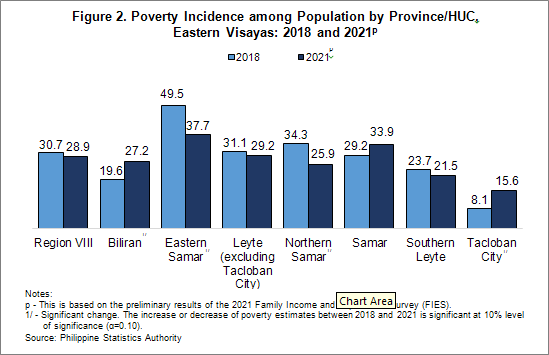
Among provinces, Eastern
Samar posted the highest poverty incidence among population in 2021
at 37.7 percent, while Southern Leyte registered the lowest poverty
incidence among population at 21.5 percent. Eastern Samar, Samar,
and Leyte (excluding Tacloban City) registered higher poverty
incidences among population than the regional figure in 2021, while
the rest of the provinces posted lower poverty incidences than the
regional estimate at 28.9 percent.
Significant improvements
in poverty incidence among population between 2018 and 2021 were
noted in Eastern Samar and Northern Samar. Poverty incidence among
population in Eastern Samar dropped to 37.7 percent in 2021 from
49.5 percent in 2018. The province of Northern Samar, meanwhile,
registered 25.9 percent poverty incidence among population in 2021,
lower than the 34.3 percent in 2018. On the other hand, poverty
incidence among population in Biliran significantly increased to
27.2 percent in 2021 from 19.6 percent in 2018 (Table 2).
Further, poverty incidence
among population in Tacloban City in 2021 significantly increased to
15.6 percent from 8.1 percent in 2018.
Subsistence Incidence
among Families
The subsistence incidence
among families in Eastern Visayas in 2021 was estimated at 7.2
percent. This means that in 2021, about 7 in every 100 families in
the region have income below the food threshold or the amount needed
to buy their basic food needs and satisfy the nutritional
requirements set by the Food and Nutrition Research Institute (FNRI)
to ensure that one remains economically and socially productive.
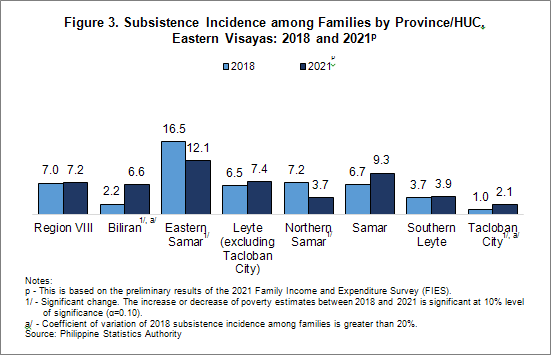
Among provinces, Eastern
Samar posted the highest subsistence incidence among families in
2021 at 12.1 percent, while Northern Samar registered the lowest
subsistence incidence among families at 3.7 percent. Eastern Samar,
Samar, and Leyte (excluding Tacloban City) registered higher
subsistence incidences among families than the regional figure in
2021. The rest of the provinces posted lower subsistence incidences
than the regional estimate at 7.2 percent.
Significant improvements
in subsistence incidence among families between 2018 and 2021 were
noted in Eastern Samar and Northern Samar. Subsistence incidence
among families in Eastern Samar declined to 12.1 percent in 2021
from 16.5 percent in 2018. The province of Northern Samar,
meanwhile, registered 3.7 percent subsistence incidence among
families in 2021, lower than the 7.2 percent in 2018. On the other
hand, subsistence incidence among families in Biliran significantly
increased to 6.6 percent in 2021 from 2.2 percent in 2018 (Table 3).
In addition, subsistence
incidence among families in Tacloban City significantly increased to
2.1 percent in 2021 from 1.0 percent in 2018.
Subsistence Incidence
among Population
Subsistence incidence
among population in Eastern Visayas in 2021 was estimated at 10.4
percent. This translates that in 2021, about 10 in every 100
individuals in the region have income below the food threshold or
the minimum amount needed to buy their basic food needs.
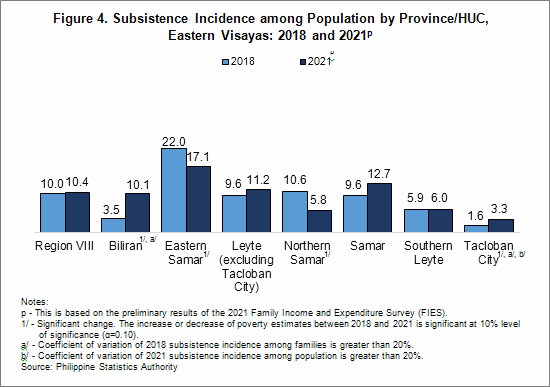
Among provinces, Eastern
Samar posted the highest subsistence incidence among population in
2021 at 17.1 percent, while Northern Samar registered the lowest
subsistence incidence among population at 5.8 percent. Eastern Samar,
Samar, and Leyte (excluding Tacloban City) registered higher
subsistence incidences among population than the regional figure in
2021. The rest of the provinces posted lower subsistence incidences
than the regional estimate at 10.4 percent.
Significant improvements
in subsistence incidence among population between 2018 and 2021 were
noted in Eastern Samar and Northern Samar. Subsistence incidence
among population in Eastern Samar decreased to 17.1 percent in 2021
from 22.0 percent in 2018. The province of Northern Samar,
meanwhile, registered 5.8 percent subsistence incidence among
population in 2021, lower than the 10.6 percent in 2018. On the
other hand, subsistence incidence among population in Biliran
significantly increased to 10.1 percent in 2021 from 3.5 percent in
2018 (Table 4).
Subsistence incidence
among population in Tacloban City significantly increased to 3.3
percent in 2021 from 1.6 percent in 2018.
Food Threshold
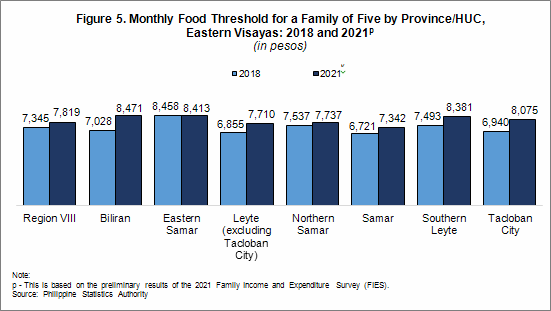
In 2021, a family of five
(5) in Eastern Visayas needed at least P7,819 per month, to meet the
family’s basic food needs. This amount represents the average
monthly food threshold for a family of five (5). This figure is 6.5
percent higher compared with the 2018 level of P7,345.
Biliran posted the highest
food threshold among the provinces in Eastern Visayas with P8,471
average monthly food threshold for a family of five (5) in 2021. On
the other hand, Samar had the lowest average monthly food threshold
for a family of five (5) at P7,342 in the same year (Figure 5).
Increases in food
threshold between 2018 and 2021 were observed in all provinces,
except in Eastern Samar, which registered a -0.5 percent decrease in
food threshold. Biliran posted the biggest increase in food
threshold at 20.5 percent (Table 5).
Meanwhile, average monthly
food threshold for a family of five (5) in Tacloban City was
estimated at P8,075 in 2021. This registered an increase of 16.4
percent compared with its P6,940 level in 2018.
Poverty Threshold
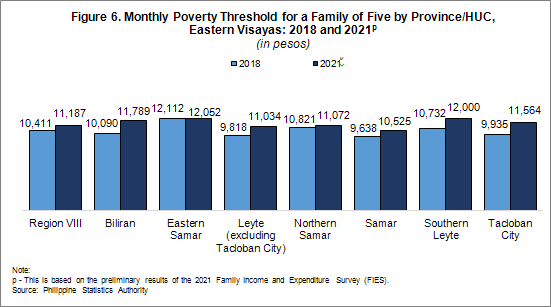
The average monthly
poverty threshold for a family of five (5) in Eastern Visayas in
2021 was estimated at P11,187, an increase of 7.4 percent from its
2018 level of P10,411. This represents the amount needed every month
to meet the family’s basic food and non-food needs.
Among the provinces, the
highest average monthly poverty threshold for a family of five (5)
was observed in Eastern Samar at P12,052 in 2021. On the other hand,
Samar registered the lowest average monthly poverty threshold for a
family of five (5) at P10,525 in the same year (Figure 6).
Increases in poverty
threshold between 2018 and 2021 were observed in all provinces,
except in Eastern Samar, which registered a -0.5 percent decrease in
poverty threshold. Biliran posted the biggest increase in poverty
threshold at 16.8 percent.
Meanwhile, average monthly
poverty threshold for a family of five (5) in Tacloban City was
estimated at P11,564 in 2021. This registered an increase of 16.4
percent compared with its P9,935 level in 2018.
Clustering of Provinces
based on Poverty Incidence
All provinces in the
country were clustered from 1 to 5 using poverty incidence among
families as the clustering variable. Cluster 1 comprises the bottom
poor provinces and Cluster 5 comprises the least poor provinces.
In 2021, two (2) provinces
moved one (1) cluster lower from their cluster categories in 2018,
namely Biliran and Samar. Two (2) provinces, Northern Samar and
Southern Leyte, moved one (1) cluster higher from their cluster
categories in 2018. The rest of the provinces maintained their 2018
cluster categories.
Among the provinces, only
Southern Leyte was categorized as Cluster 4. Three (3) provinces,
namely: Biliran, Leyte (including Tacloban City), and Northern Samar
belonged to Cluster 3, while Eastern Samar and Samar were classified
in Cluster 2.
◄◄home
I
next►►
